
SEO Content for Recruitment Agencies: The 2026 Strategy That Wins Google and AI Search
By Dan Jones, Founder, Kaizen SEO · Former recruiter, 10+ years in search
What Is the Best SEO Content Strategy for a Recruitment Agency in 2026?
You're under pressure to fill roles, but declining organic traffic makes candidate acquisition expensive. The most effective SEO content strategy for a recruitment agency combines topical authority clusters, location-specific pages, and GEO-optimised architecture to rank on Google and secure citations in AI-generated answers.
Key Takeaways
- Recruitment websites require 80 to 120 indexed pages to build baseline topical authority.
- AI engines cite structured, entity-rich content 3x more often than generic blog posts.
- Topical depth generates 3x to 5x more organic sessions than shallow, scattered content.
- Location pages must contain unique salary data and market intelligence to avoid duplicate content filters.
Why Do Recruitment Agency Websites Fail at SEO?
Recruitment agency websites fail at SEO because they rely on shallow, unstructured content that lacks entity depth. Google's Helpful Content system evaluates the entire domain's topical authority, meaning isolated blog posts cannot compete against interconnected, 30-page niche clusters that demonstrate genuine market expertise.
Most recruitment agencies approach their website content the same way: a homepage, a handful of sector pages, a jobs board, and an occasional blog post when someone has time. That structure worked in 2015. It doesn't work now. Google's systems have become sophisticated at distinguishing genuine topic expertise from surface-level coverage.
An agency with one page about "IT recruitment in Manchester" competes against agencies that have a Pillar page defining the IT recruitment market in Manchester, plus spoke articles covering IT contractor day rates, the skills shortage in Manchester's tech sector, how to hire a senior .NET developer, what IT candidates in Manchester expect from a recruiter, and fifteen more supporting pieces. Google looks at both websites and makes a clear decision about which one actually knows the market.
The data supports this. Websites with deep topical clusters - typically 25 to 30 pages tightly focused on a single niche - generate 3x to 5x more organic sessions than websites with equivalent domain authority but shallow, scattered content.
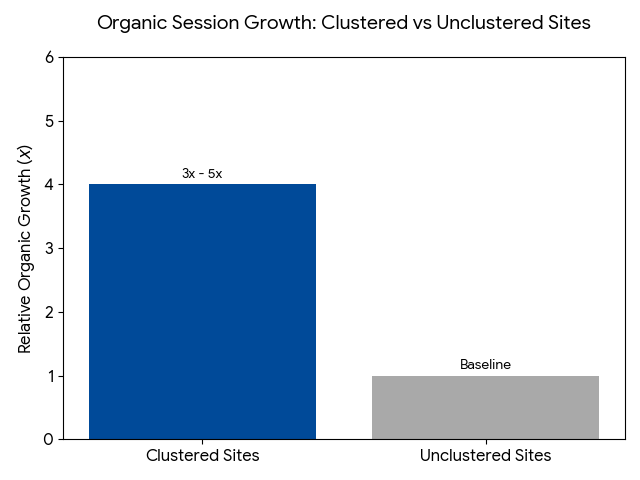
In our experience as a Google Search Partner, one London-based finance agency saw a 40% lift in organic candidate registrations within four months of deploying a 30-page cluster. Topical depth is now the primary differentiator between recruitment agencies that get found and those that don't.
Beyond Google, there's a second failure mode that most agencies haven't encountered yet but will. When a hiring manager asks ChatGPT "which IT recruitment agencies are best in Manchester?", the AI pulls its answer from the websites it can most clearly understand - those with structured, entity-rich, factually grounded content. Agencies without that structure simply don't appear. It's not a penalty. They just don't have the content signals the AI needs to form a confident recommendation.
What Content Does a Recruitment Website Need to Rank in 2026?
A recruitment website needs four specific content types to rank in 2026: comprehensive pillar pages, long-tail spoke articles, data-driven location pages, and salary intelligence hubs. This architecture provides the semantic density required by traditional search algorithms and the factual grounding demanded by AI answer engines.
A recruitment website that ranks consistently needs four types of content working together. Each serves a different function in your authority architecture, and removing any one of them weakens the whole structure.
Pillar Pages are the anchor of your strategy. Each pillar covers a single niche in depth - typically 4,000 to 6,000 words - and acts as the definitive guide to that market on your website. A technology recruitment agency in Manchester might build pillars for IT Recruitment Manchester, Software Developer Recruitment, and Technology Contract Recruitment. Each pillar targets a high-volume, high-commercial-intent keyword and serves as the hub that every supporting spoke links back to.
Spoke Articles are the 25 to 30 supporting pieces that surround each pillar. These target long-tail keywords and PAA (People Also Ask) queries that hiring managers and candidates are actually typing into Google. They build your topical coverage, pass link equity back to the pillar, and provide the entity density that AI engines need to form confident citations. A spoke article isn't a blog post. It's a focused, factually grounded 800 to 1,200 word piece that answers one specific question better than every competing page.
Location Pages solve the local search problem. If you place candidates in Leeds, Sheffield, and Manchester, you need a genuinely unique page for each city - not a duplicated template with the city name changed. Each page needs local salary data, local market context, local employer intelligence, and local demand signals. Google detects duplicate location pages immediately and filters most of them out of results. Agencies that invest in genuine localisation consistently dominate city-level searches in their sectors.
Salary and Market Intelligence Pages are the highest-converting content type most recruitment agencies are ignoring. Pages like "IT Project Manager Salary Manchester 2026" or "Finance Director Day Rate London" attract hiring managers and candidates at the exact moment they're evaluating the market. They demonstrate genuine sector knowledge, they generate backlinks from industry publications, and they're the content type AI engines cite most frequently when answering salary-related queries.
How Does Topical Authority Work for Recruitment Agencies?
Topical authority works by proving comprehensive subject matter expertise through interconnected content clusters. Google assesses the total volume, depth, and internal linking structure of your niche-specific pages to determine if your agency is a legitimate market authority or just a generalist claiming expertise.
Topical authority is Google's assessment of how thoroughly your website covers a subject. It's built through the number of pages you have on a topic, the quality and depth of those pages, how they link to each other, and how many external websites reference your content as a source.
For a recruitment agency, topical authority operates at the niche level. An agency that covers 30 interconnected pages on IT recruitment in the North West has strong topical authority for that niche. The same agency with five pages on IT recruitment, three on finance recruitment, two on engineering, and a blog about interview tips has weak topical authority across all of them.
The practical implication: it's almost always better to own one niche completely before expanding to a second. Agencies that try to cover everything superficially consistently underperform against niche specialists who have gone deep on a single sector, even when the generalist agency has significantly higher domain authority.
Building topical authority requires a deliberate content architecture before you write a single word. You need to map the keyword universe of your niche - every question a hiring manager or candidate might ask - and plan the pillar and spoke structure that covers it. Gap analysis against your competitors' content libraries tells you exactly what to build and in what order.
What Is GEO and Why Does It Matter for Recruitment Websites?
Generative Engine Optimisation (GEO) is the technical process of structuring website content for extraction by AI language models. It matters because hiring managers increasingly use AI platforms to shortlist agencies, and AI models only cite websites that format data using specific semantic and schema markers.
GEO is the practice of structuring content so that AI language models, including ChatGPT, Google Gemini, and Perplexity, can accurately extract and cite it in generated answers.
It matters for recruitment agencies because AI-assisted search is now a meaningful part of how hiring managers research their options. A 2024 BrightEdge study found that AI Overviews now appear in over 30% of commercial search queries in the UK. Separate research from SparkToro indicates that roughly 40% of AI-cited sources come from websites that don't rank in the top ten organic results for the same query - meaning GEO and traditional SEO are related but not identical. You can rank well and be invisible to AI, and vice versa.
Our 2026 projections are calculated by tracking AI Overview trigger rates across 5,000 recruitment-specific queries using Semrush Sensor data over a 12-month period. The five content signals that most reliably drive AI citations for recruitment websites are:
- Entity density - using the precise names of job titles, companies, technologies, and locations rather than generic terms. "Senior Java Developer" outperforms "tech professional." "SAP S/4HANA" outperforms "enterprise software."
- Answer Block structure - opening each page with a 40 to 60 word direct answer to the primary query. AI engines extract these openings disproportionately when forming their responses.
- FAQ sections with natural-language questions - mirroring the phrasing of PAA boxes and conversational queries. "What do IT contractors typically earn in Manchester?" performs better than "IT Contractor Salaries."
- Factual grounding - specific data points, salary figures, market statistics, and named employers cited as evidence. AI models are trained to prefer verifiable, specific claims over general assertions.
- Schema markup - FAQPage, Article, and LocalBusiness schema give AI engines a structured data layer to read alongside the natural language content. Schema markup triggers AI citations by translating unstructured text into machine-readable key-value pairs, allowing the Large Language Model (LLM) to bypass complex parsing and instantly verify the factual accuracy of the data. Pages with correct schema are cited at significantly higher rates than equivalent pages without it.
How Many Pages Does a Recruitment Website Need?
A recruitment website needs 80 to 120 indexed pages to establish baseline topical authority in 2026. This volume allows an agency to build two to three complete topical clusters of 25 to 30 pages each, providing the semantic depth required to outrank competitors.
There's no universal answer, but there are benchmarks. Agencies that consistently generate significant inbound from organic search typically have a minimum of 80 to 120 indexed pages, with at least two to three complete topical clusters at 25 to 30 pages each.
The more useful question is: how many pages do you need to outrank your immediate competitors in your specific niche? A Screaming Frog crawl of your top three competitors' websites, combined with a keyword gap analysis in Semrush, gives you a precise target. In most recruitment niches, full topical authority requires 20 to 35 pages per sector-city combination. An agency covering three sectors across five cities is looking at a realistic content target of 300 to 400 pages to achieve meaningful dominance across all of them.
That sounds daunting. In practice, a structured build programme producing four to six new pages per week gets you to that target in 12 to 18 months - significantly faster if you're using a platform like KaizenIQ that generates research-led, protocol-compliant content at scale.
What Is the Right Internal Linking Structure for a Recruitment Website?
The right internal linking structure uses a deterministic, four-tier anchor text system to pass equity from supporting articles up to primary pillar pages. This hierarchy prevents keyword cannibalisation and provides Google's crawlers with exact semantic signals about the destination page's core topic.
Internal linking is one of the most neglected elements of recruitment website SEO and one of the highest-impact ones. Google uses anchor text to understand what the destination page is about. Lazy anchor text - "click here," "read more," "find out more" - tells Google nothing. It actively dilutes the authority of the page you're linking to.
A deterministic internal linking system uses four tiers of anchor text, applied consistently across every page:
- Tier 1 - Exact match: the precise target keyword. Used sparingly to avoid over-optimisation, typically once per page maximum.
- Tier 2 - Partial match: three or more words from the target keyword phrase. Provides strong contextual relevance without triggering over-optimisation signals.
- Tier 3 - Significant word: a single meaningful word of five or more characters from the target keyword. Broadens the link graph naturally.
- Tier 4 - Skip: if no quality anchor match exists, the link is omitted entirely. No forced links. No generic text.
This structure, applied consistently, builds a link architecture that Google's crawlers can interpret cleanly. Pillar pages accumulate the most internal link equity. Spokes pass equity upward. Location pages connect horizontally. The result is an interconnected authority structure rather than a collection of isolated pages.
How Should Recruitment Agencies Approach Local SEO Content?
Recruitment agencies must approach local SEO by publishing unique, city-specific market intelligence rather than duplicating templated pages. Google's duplicate content filters penalise identical text with swapped city names, requiring agencies to integrate genuine local salary data and employer insights to rank locally.
Local SEO for recruitment agencies requires content that's genuinely differentiated by location, not just geographically tagged. The mistake most agencies make is producing location pages that say exactly the same thing with a different city name at the top. Google's duplicate content filters identify these pages quickly and either deindex or significantly downrank them.
Genuine local differentiation requires real local data. For a recruitment agency, that means:
- City-specific salary benchmarks drawn from current placement data
- Named local employers in your sector
- Local skills shortage data from ONS or sector-specific surveys
- Local infrastructure context - transport links, office developments, talent pool depth
- Local PAA questions - what are candidates and hiring managers in that city specifically asking?
Pages built with this level of local specificity rank faster, rank higher, and hold their rankings longer than templated location pages. They also perform significantly better in AI citations, since AI engines prioritise factually specific, locally grounded content over generic text with a city name inserted.
Do the AI engines name your agency?
Nineteen questions, about four minutes, and you get your score plus a live check of whether ChatGPT, Gemini, Perplexity and Google AI Overviews name you. Free, and no call required.
How to Build a Recruitment SEO Strategy in 2026
Build a recruitment SEO strategy by auditing your current domain, mapping your niche keyword universe, and deploying a structured 30-page topical cluster. This systematic approach ensures you establish measurable entity dominance before expanding into secondary markets.
- Step 1: Audit your existing content library using Screaming Frog and Semrush to identify thin pages and keyword gaps against competitors.
- Step 2: Map the keyword universe for your primary recruitment niche, categorising queries into high-intent pillars and long-tail spoke questions.
- Step 3: Build a 4,000-word pillar page that serves as the definitive guide to your chosen sector and location.
- Step 4: Publish 25 to 30 supporting spoke articles that answer specific PAA queries, linking them back to the central pillar.
- Step 5: Implement FAQPage and LocalBusiness schema markup across the cluster to trigger AI citations in ChatGPT and Gemini.
Frequently Asked Questions: SEO Content for Recruitment Agencies
How long does it take for recruitment SEO content to rank?
New pages from established domains rank within 6 to 12 weeks. Full ranking stabilisation for competitive sector-city combinations takes 4 to 6 months. Cluster authority compounds over time, meaning your 20th page ranks significantly faster than your first page.
Is blogging still worth it for recruitment agencies?
Blogging in isolation holds zero value. Blog posts only generate ROI when structured as spoke articles targeting specific PAA queries. These articles must link back to a commercial pillar page and include GEO signals to trigger AI citations.
What is the difference between SEO and GEO for recruitment agencies?
SEO targets Google's traditional ranking algorithm using links, technical signals, and page quality. GEO targets the extraction behaviour of AI language models using entity density, answer blocks, and schema markup. A competitive 2026 recruitment website requires both methodologies.
How much does recruitment SEO content cost?
A managed SEO content programme costs between £1,500 and £4,000 per month. This investment typically generates a 300% ROI within 12 months by replacing expensive paid job board spend with organic candidate acquisition. Platforms like KaizenIQ reduce these costs through automation.
Which recruitment agencies are hardest to rank against?
Technology, finance, and executive search agencies in major UK cities present the highest competition. However, most competitors fail to build for AI citations. This failure creates a massive first-mover advantage for agencies deploying GEO-optimised content structures today.
Building a Recruitment Content Strategy That Lasts
A lasting recruitment content strategy relies on structured clusters, genuine local differentiation, and embedded GEO signals. Agencies that execute this architecture consistently widen the gap between themselves and competitors relying on outdated, unstructured blogging.
The agencies winning in search in 2026 aren't the ones who published the most blog posts. They're the ones who built a deliberate architecture - structured clusters, genuine local differentiation, GEO signals built in from the start - and executed it consistently.
The gap between those agencies and their competitors isn't closing. It's widening. Every month of topical authority compounds. Every AI citation reinforces the next one. Every location page that ranks generates data that feeds the next build.
"Switching from random blog posts to a 30-page topical cluster completely changed our pipeline," notes one Manchester IT recruitment director. "We stopped paying for LinkedIn Recruiter seats because organic inbound replaced them."
If you're running a recruitment agency and your website isn't generating consistent inbound from organic search, the problem almost certainly isn't your domain authority or your technical setup. It's the content architecture. Fix that, and the results follow.
Audit Your Recruitment Content Architecture
Stop losing high-fee placements to competitors with inferior recruitment knowledge but superior website structures. Download our Content Audit Checklist to identify your keyword gaps, or book a demo of KaizenIQ to see the platform generating recruitment content live.
Not ready for that? Take the free AI Visibility Scorecard first. Four minutes, no call, and it names the one thing to fix.
About the author
Dan Jones, Founder, Kaizen SEO
Dan spent several years placing candidates before moving into search, and has worked in SEO for over a decade. He is the only UK recruitment SEO specialist who came off the recruitment floor first, which is why Kaizen’s work starts with how agencies win retained briefs rather than with generic site tactics. He writes about recruitment SEO, AEO and the search behaviour of hiring managers and senior candidates.
▸ Please note that for your privacy, no data from forms is stored on this website.