
How AI Is Transforming SEO and Recruitment Marketing
By Dan Jones, Founder, Kaizen SEO · Former recruiter, 10+ years in search
AI in Recruitment Marketing and SEO Transformation
Recruitment marketing and SEO feel harder than ever when AI answer engines strip clicks from the very queries you used to own. SGE snapshots, ChatGPT answers, and Gemini overviews now sit between your brand and your candidates, even when your content deserves the click.
For most recruitment marketers, the pressure is simple: keep filling pipelines without extra budget, while search changes faster than your content calendar. You cannot pause hiring campaigns while you “wait and see” how AI settles.
Key takeaways
- AI in recruitment marketing shifts visibility from classic blue links to AI summaries, entity citations, and intent-led answers across Google SGE, ChatGPT, and Gemini.
- SEO for recruitment agencies now feeds AI answer engines, so structure, schema, and topical authority matter more than raw rankings for candidate and client queries.
- Entity-based optimisation, question-led content, and FAQ-rich service pages give AI systems precise recruitment signals they can quote in snapshots and assistants.
- AI-powered keyword research, intent modelling, and automated content distribution let lean marketing teams scale campaigns without sacrificing human-led positioning or compliance.
How is AI changing SEO for recruitment marketing?
AI is changing SEO for recruitment marketing by moving the goal from “rank for keywords” to “be the most trustworthy, structured answer that AI systems can reuse in summaries.”
In practice, AI layers like Google’s Search Generative Experience show an AI-generated block that answers the query directly, then cite a handful of sources, often different from the top organic results. For recruitment searches, that means your carefully crafted “IT recruitment agency London” page might still sit in position 3, while SGE answers the query with salary guidance, process explanations, and agency shortlists pulled from other sites. If you do not design your content for extraction, you lose visibility even when you “rank”.
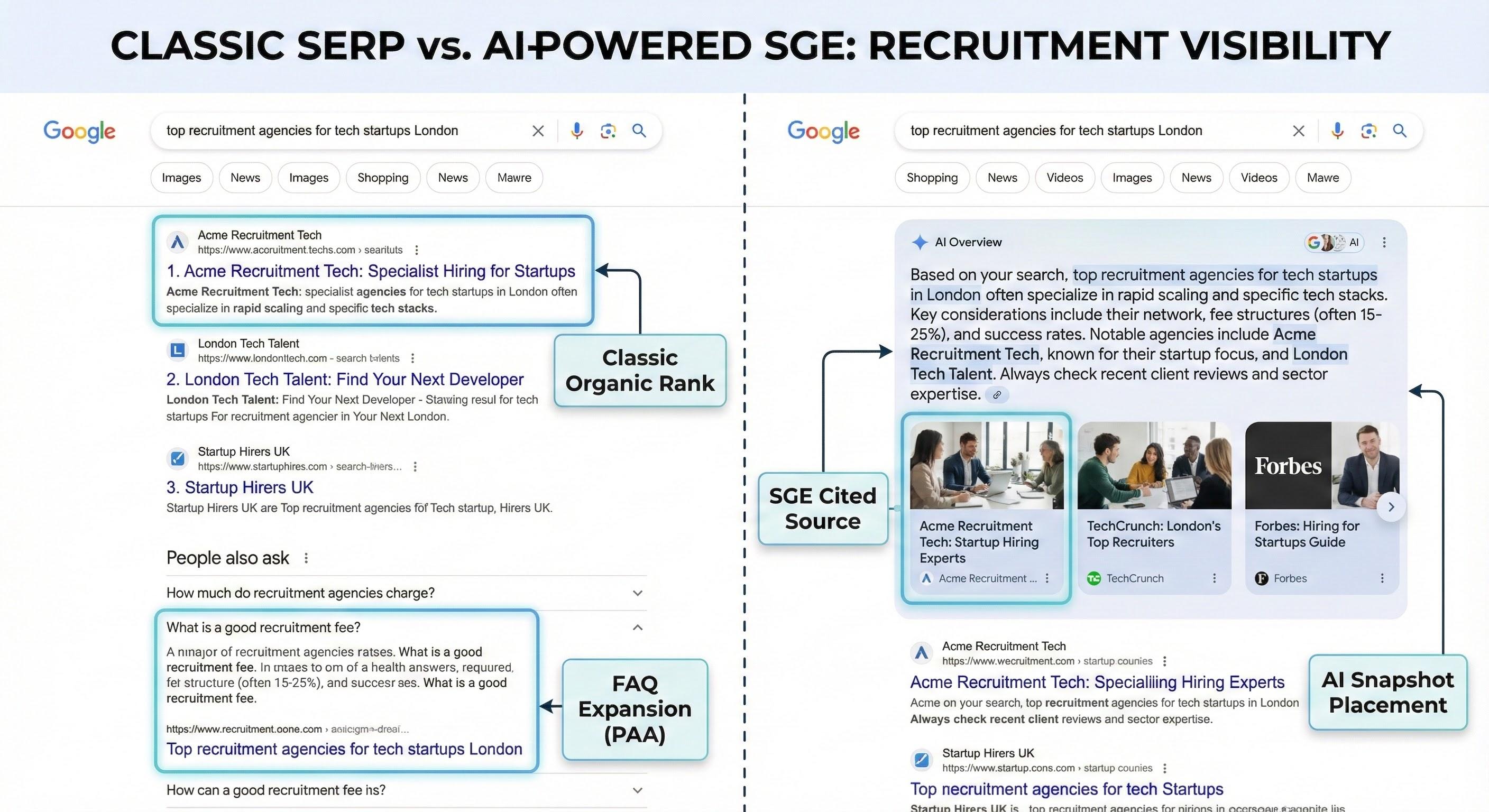
SGE and zero-click recruitment search behaviour.
SGE and zero-click recruitment search behaviour reduce visits from informational queries while increasing the importance of brand presence inside the AI snapshot.
Early SGE analyses show AI overviews appear most often on complex, long-tail, question-led queries, which are exactly the searches candidates and hiring managers use when they ask about roles, salary bands, and how to choose an agency. Users get enough information from the AI block to shortlist options without scrolling, so clicks concentrate on whatever brands the snapshot cites. In our experience with recruitment SEO, agencies that answer niche, question-based topics with clear headers, short definitions, and supporting FAQs appear more frequently as cited sources, even when they are not the top organic result.
Entity-based optimisation for recruiters
Entity-based optimisation for recruiters means structuring your site so search engines understand exactly who you serve, what roles you fill, and where you operate, instead of guessing from broad keywords.
AI systems and SGE lean heavily on Knowledge Graph-style data, so they favour brands that describe services and sectors in a consistent, structured way across pages, schema, and external profiles. For a recruitment agency, that means:
- Map each niche (for example, fintech, construction, healthcare) to explicit entities in copy, headings, and schema.
- Use Organization, Service, and JobPosting schema with clear sector, location, and seniority fields so AI can confirm what you actually do.
- Standardise naming for your agency, consultants, and divisions so mentions across LinkedIn, directories, and partner sites reinforce the same entity.
We often see agencies lose AI visibility because they dilute sector pages with off-topic blogs (“general CV tips”), creating weak entity signals that SGE ignores.
How AI improves recruitment targeting and automation
AI improves recruitment targeting and automation by turning messy search and CRM data into structured intent signals you can use to prioritise content, channels, and follow-up.
Modern AI tools can cluster thousands of query variations into a small set of candidate and client intents, such as “compare agencies,” “research salary ranges,” or “learn about a role path.” For recruitment marketers, that means less time in spreadsheets and more time building assets that align tightly with profitable segments. AI then supports automation across distribution: repurposing SEO content into email, social, and paid assets that stay consistent with the original intent.
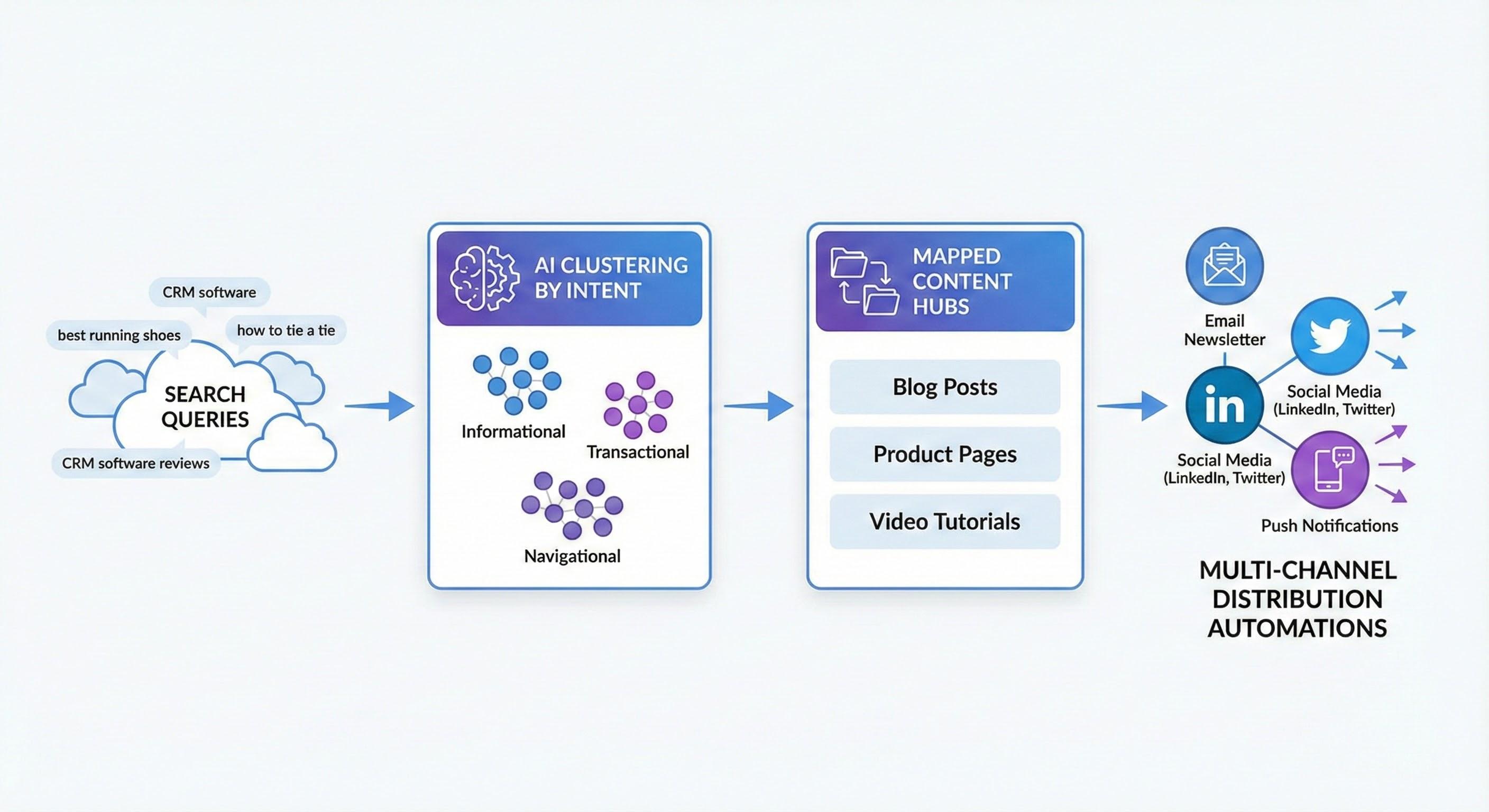
AI-driven keyword and intent modelling
AI-driven keyword and intent modelling uses language models to group recruitment search terms by what the user actually wants to do, not just by shared wording.
Instead of manually categorising hundreds of variations like “engineering recruitment agency Bristol” and “Bristol mechanical engineer recruiter,” you can feed exports from Search Console, paid search, and internal search into AI to tag intent at scale. In our experience, this quickly reveals content gaps that classic keyword tools hide, such as underserved long-tail questions about hybrid working, contractor compliance, or local salary expectations in specific niches. You then brief pages and campaigns against intent clusters, ensuring each page targets one clear job-to-be-done for the user and one clear commercial outcome for your agency.
Automation in recruitment content distribution
Automation in recruitment content distribution uses AI to turn core SEO assets into channel-specific pieces and schedule them across candidate and client journeys without manual duplication.
Recruitment marketers can use AI to:
- Generate LinkedIn carousels, recruiter talking points, and nurture email snippets from a single long-form page, while keeping messaging aligned with the original search intent.
- Auto-tag blogs and guides by sector, seniority, and funnel stage so CRM and marketing automation platforms serve them to the right lists.
- Produce structured briefs for consultants to record short videos that answer the same queries your SGE-targeted pages already cover.
We often see strong gains when agencies treat SEO content as the source of truth and let AI handle repurposing, instead of writing disconnected posts for each channel.
Should recruiters use AI tools for SEO?
Recruiters should use AI tools for SEO to scale research, ideation, and execution, while keeping human specialists in control of positioning, compliance, and performance decisions.
Used well, AI reduces time spent on repetitive SEO tasks and frees marketers to focus on value: choosing which roles, sectors, and locations deserve investment right now. Used badly, AI floods your site with generic content that weakens topical authority and confuses SGE about where you are genuinely expert. The dividing line is simple: let AI do the heavy lifting on data and drafts, but let humans set the strategy and sign-off.
Risks of generic AI content
Risks of generic AI content include losing rankings to more specific competitors, harming E-E-A-T signals, and triggering AI systems to ignore your pages as low value.
Recruitment is already full of duplicated “what does a project manager do?” content. When agencies push out unedited AI drafts that say nothing unique about their market, they create a risk that:
- SGE finds no reason to cite them, because other sites provide clearer, more specific explanations.
- LLMs treat their domain as noise in future training cycles, weakening long-term visibility in AI assistants.
- Compliance and brand issues emerge if content makes unapproved claims about salaries, benefits, or discrimination policy.
In our experience, the strongest recruitment content combines AI-generated structure with consultant-led nuance: local knowledge, niche-specific hiring realities, and process details you will not find in generic guides.
Human-led strategy with AI execution
Human led strategy with AI execution means letting specialists decide what to rank for and how to differentiate, then using AI to accelerate every step after that decision.
A practical setup for recruitment agencies:
- Strategy: Define sectors, locations, and personas where you want to win, based on margin and fill rate data, led by your marketing lead and senior consultants.
- Planning: Use AI to analyse search, CRM, and job board data, then propose topic clusters, FAQs, and internal links that support those priorities.
- Production: Let AI draft outlines, schema, and first-pass copy, but insist that humans add case studies, process detail, and compliance checks before publishing.
Agencies that work this way move faster than competitors who either avoid AI entirely or publish everything the model suggests.
How to adapt recruitment SEO and marketing strategies for AI driven search
How to adapt recruitment SEO and marketing strategies for AI driven search comes down to making your site easy for AI systems to quote, verify, and recommend for specific recruitment tasks.
Step 1: Audit AI visibility and entities.
Identify where your agency already appears in SGE, AI overviews, and assistants for brand and non-brand recruitment queries. Search priority terms, record whether AI cites you, and note which entities (sectors, locations, role types) appear around your brand. Use this to define your “real” AI footprint, not just your organic rankings.
Step 2: Rebuild key pages for extraction
Rewrite core service, sector, and location pages so each one leads with clear definitions, short paragraphs, question-based subheadings, and in-page FAQs. Add concise glossaries for recruitment-specific terms and ensure every important answer sits close to the relevant heading so AI can lift it cleanly.
Step 3: Upgrade schema and internal linking
Implement Organization, Service, and JobPosting schema, and add Article schema to key guides, linking them back to your services. Use internal links to connect AI-focused guides, pillar pages on AI-ready recruitment SEO, and niche service pages, so crawlers see a coherent authority cluster for each sector you care about.
Step 4: Build AI-assisted content workflows
Document how your team will use AI for research, briefs, outlines, and drafts, including which tools they can use and where human sign-off is mandatory. Connect AI outputs into your CMS and automation tools so you repurpose every SEO asset across email, social, and sales enablement without duplicating work.
Step 5: Monitor AI changes and iterate
Review SGE and assistant results quarterly for your key recruitment themes, watch which pages lose or gain AI visibility, and adapt briefs accordingly. Track not just organic traffic, but assisted outcomes: inbound roles, candidate registrations, and client enquiries that started with AI surfaces.
FAQs
How is AI changing recruitment marketing?
AI is changing recruitment marketing by shifting discovery from simple rankings to AI summaries, entities, and intent-based answers across search and assistant platforms. Recruitment marketers must optimise content, schema, and workflows so AI can understand niches, trust claims, and surface their brand for specific hiring tasks.
Does AI affect SEO for recruiters?
AI affects SEO for recruiters by rewarding structured, topical authority-led content instead of basic keyword pages. Systems like SGE pull concise answers from sites that clearly define services, sectors, and locations, backed by schema and consistent external signals, so agencies must write for extraction, not just ranking.
Should recruiters use AI tools?
Recruiters should use AI tools to speed up research, intent analysis, and content production, while keeping humans in charge of strategy and compliance. This balance lets lean teams compete with larger agencies, without flooding their domain with generic content that AI systems ignore or downrank.
How do SGE and AI search impact candidate journeys?
SGE and AI search impact candidate journeys by answering many early questions directly in the results, reducing clicks but increasing the influence of brands cited in summaries. Agencies need content that addresses detailed, long-tail questions so AI treats them as trusted explainers and routes candidates their way.
What content should recruitment agencies prioritise for AI visibility?
Recruitment agencies should prioritise sector, role, and location pages with strong FAQs, plus deep guides on hiring processes, salary ranges, and compliance topics. These topics map closely to informational and consideration-stage queries where SGE and assistants rely on clear, expert sources to build their answers.
Author Bio
Dan Jones is a specialist recruitment SEO and AI visibility strategist with Kaizen SEO Limited. Dan works hands-on with recruitment agencies to align SEO, schema, and content with SGE and AI assistants, helping teams protect inbound performance while adapting to AI-led search behaviour.
Book a consultation with Kaizen SEO Limited to turn your recruitment site into an AI-ready authority that wins visibility, citations, and enquiries across Google, SGE, ChatGPT, and Gemini before your competitors do.
About the author
Dan Jones, Founder, Kaizen SEO
Dan spent several years placing candidates before moving into search, and has worked in SEO for over a decade. He is the only UK recruitment SEO specialist who came off the recruitment floor first, which is why Kaizen’s work starts with how agencies win retained briefs rather than with generic site tactics. He writes about recruitment SEO, AEO and the search behaviour of hiring managers and senior candidates.
▸ Please note that for your privacy, no data from forms is stored on this website.